Reflective Surface (Glasses Lens)
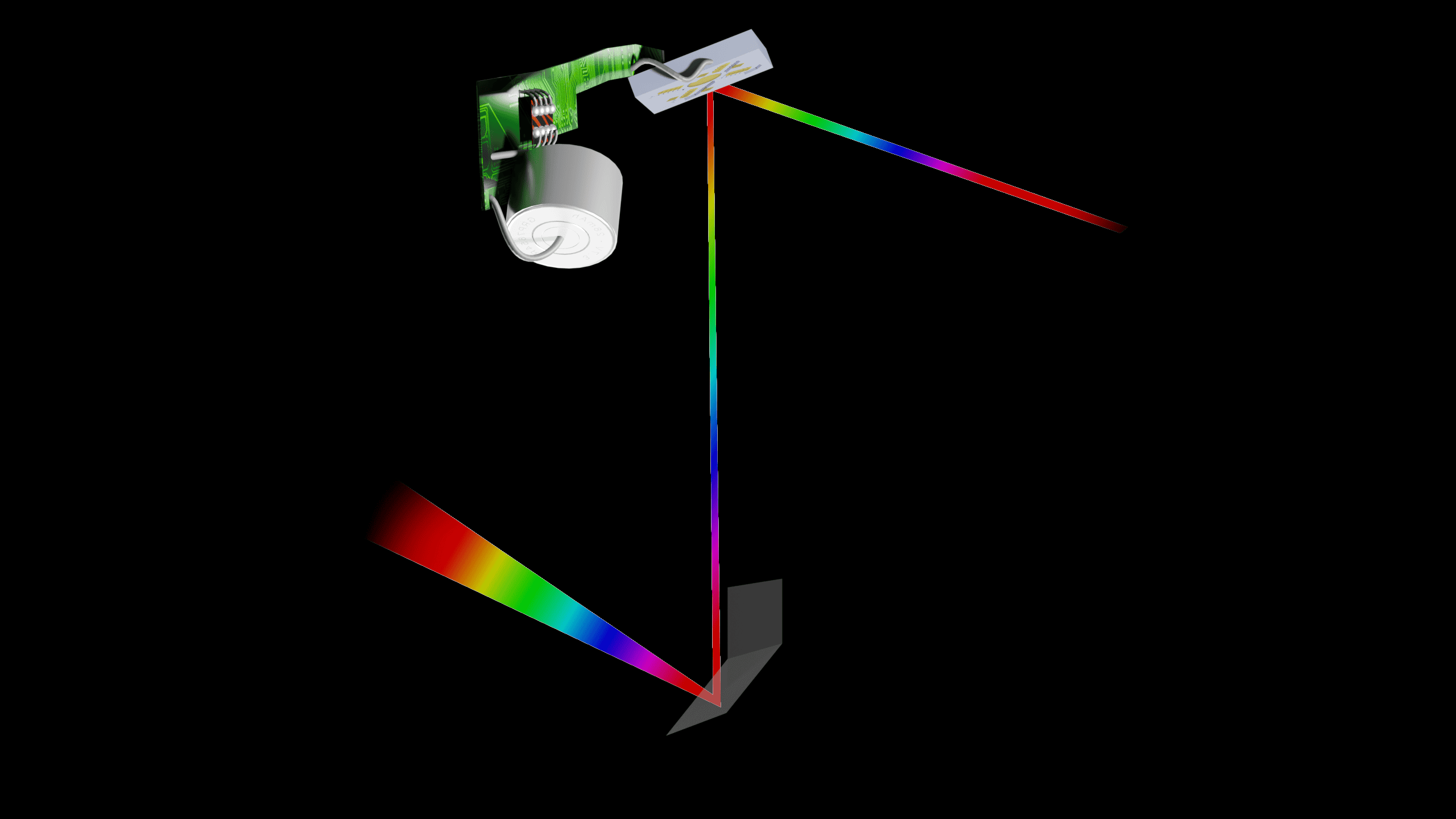
The reflective surface integrated into the glasses lens is a crucial component of the Holo Lux projection system, as described in the “LED Projection System with Passive MEMS Display” document. Its primary function is to superimpose the projected image onto the user’s view of the real world.
Importance of Optical Quality and Coating:
To ensure an optimal visual experience, the optical quality and coating of the reflective surface are of paramount importance. High optical quality is necessary to minimize distortions of the projected image, ensuring that the user perceives a sharp and faithful image. The coating, on the other hand, is essential to maximize the transparency of the lens, allowing the user to clearly see the surrounding environment, and to optimize the reflection of the projected light, ensuring good brightness and contrast of the virtual image.
Simple and Suitable Configuration: 50% Beam Splitter at 45°
The simplest, most suitable, and often recommended configuration for the reflective surface in systems like Holo Lux is one that uses a beam splitter with a reflectivity of 50%. In this configuration:
- The reflective surface is made of a semi-transparent material.
- It is designed to transmit approximately 50% of the light from the external environment, allowing the user to see through the lens.
- It reflects approximately 50% of the light projected by the LED system towards the user’s eye, making the virtual image visible.
- The typical inclination of this surface is 45° with respect to the user’s visual axis. This angle allows the projected light to be deflected towards the eye without excessively obstructing direct vision.
This configuration offers a good compromise between the visibility of the real world and the brightness of the projected image, and it is relatively simple to implement.
Other Reflective Systems for Augmented Reality:
Beyond the classic 50% beam splitter, there are other reflective systems used or potentially usable in augmented reality applications, although they may present greater complexity or compromises:
- Wavelength Selective Reflective Surfaces: These surfaces are designed to specifically reflect the wavelength of light emitted by the projection system and transmit other wavelengths. This can improve the contrast of the projected image without excessively compromising transparency for real-world vision. However, they require a monochromatic light source or one with a narrow spectral band.
- Diffractive Optical Elements (DOE): Diffractive optical elements can be used to create complex reflective surfaces that efficiently guide projected light towards the user’s eye. They can offer advantages in terms of compactness and field of view, but their design and fabrication can be more complex.
- Waveguides with Diffraction Gratings: In some AR systems, the image is projected into a waveguide and then extracted towards the eye using diffraction gratings. Although they are not reflective surfaces in the traditional sense, they perform a similar function in redirecting light to the user’s eye.
Considerations for Holo Lux:
Considering the need for a passive and potentially low-cost system, the 50% beam splitter configuration with a 45° inclination likely represents the most suitable and recommended solution for Holo Lux, as suggested in the document. It offers a good balance between performance and simplicity of implementation. Exploring other reflective technologies could be considered for future developments or for specific applications that require superior performance in terms of brightness or transparency, but at the cost of greater complexity.